
- The 40oz size is the format that won, not the largest or the cheapest. It converged at the intersection of all-day hydration, social-media visibility culture, and the practical carry-and-cup-holder fit that smaller and larger sizes cannot match.
- The handle is not cosmetic. It unlocked the format for gym, commute, and stroller use cases that had kept larger sizes out of the daily-carry category, and it is now table stakes for US retail.
- Spec quality is determined by 18/8 steel, double-wall vacuum, lid type, and the mill test certificate. A sub-grade steel is the most common silent compromise in low-cost private-label tumblers.
- Logo decoration is a tiered choice, not a single decision. Laser engraving for premium permanence, UV print for full-colour detail, silk screen for cost-effective single-colour, heat transfer for full-wrap designs at volume.
- Production lead time is around 35 to 50 days end-to-end. A US buyer targeting a back-to-school or holiday launch should place the purchase order 90 days before the in-store date to absorb production and ocean transit.
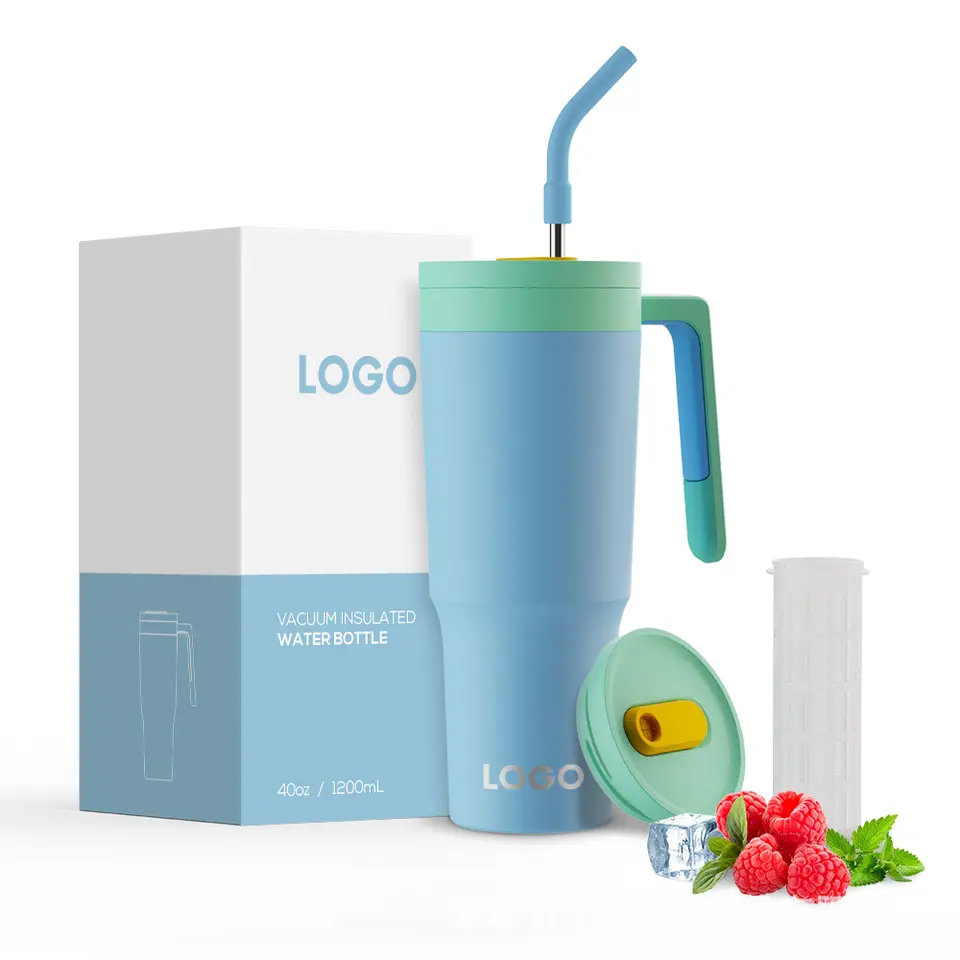 The 40oz format with integrated handle and flip-straw lid is now the default US retail configuration for stainless steel drinkware. Source: SUNSUM 40oz customizable tumbler product page.
The 40oz stainless steel tumbler with handle is now the single most replicated drinkware SKU format in US retail. Walk into a mass-market club store, a mid-market grocery chain, an outdoor retailer, or a campus bookstore in 2026 and the same silhouette shows up on shelf after shelf: powder-coated matte body, integrated soft-grip handle, flip-straw or slider lid, full-wrap decoration, and a brand mark on the front panel. As a drinkware manufacturer in Ningbo with a full stainless steel tumbler production line that ships custom 40oz tumblers into US retail channels, I have watched this format climb from a single niche product in 2021 to the dominant private-label platform by 2024, and I want to walk through why the format won, what spec details actually matter to a private-label buyer, and how to structure a factory-direct bulk order from China without the most common sourcing mistakes.
Why 40oz Won: The Convergence of Three US Consumer Habits
The 40oz format is not the largest size on the market (64oz novelty tumblers exist), not the cheapest (sub-20oz promotional tumblers still dominate giveaways), and not the most premium (20oz to 24oz ceramic-lined or vacuum-insulated artisan bottles occupy the high-end). The 40oz format won because it is the only size that satisfies three US consumer habits simultaneously, and once a major mass retailer launched a 40oz-with-handle SKU at a sub-premium price point, every other channel had to follow.
- Habit 1: All-day single-bottle hydration
- US consumer behaviour has shifted decisively toward single-bottle all-day hydration since the late 2010s, driven by sustainability messaging around single-use plastics and by workplace wellness programs that encourage water intake tracking. A bottle below 30oz requires a refill before the typical eight-hour shift, and the refill friction is enough to push adoption below the line. A 40oz bottle covers the full day for most consumers, which is why this is the format the wellness, fitness, and influencer communities standardised on.
- Habit 2: Visibility-driven social-media cup culture
- The 40oz size is large enough to be visibly photographed, decorated, and customised in a way that a 20oz or a 30oz is not. The body panel is wide enough for full-wrap designs, large enough to carry a brand mark that reads from across a gym, and tall enough to sit prominently on a desk or in a car cup holder in the background of a video call. The visibility-driven cup culture that exploded through 2023 and 2024 is the format’s strongest tailwind, and it is why the 40oz silhouette is now a fixture in US lifestyle content.
- Habit 3: Practical carry and cup-holder fit
- Sizes above 50oz stop fitting in standard US car cup holders, which removes them from the daily-commute use case that drives most bottle purchases. Sizes below 30oz feel too small to justify the cold- or hot-retention engineering investment. The 40oz format, with the addition of an integrated or soft-grip handle, fits the cup holder of nearly every US sedan, SUV, and light truck sold in the last decade, and the handle solves the carry problem that had kept larger sizes out of one-handed use cases like stroller pushing, gym lifting, and office walking.
The convergence of these three habits is why 40oz is not a fashion that will fade by 2027. The format is anchored to physical constraints (cup-holder fit, all-day hydration), not to a fashion cycle, and the brands that standardised on the format have built their entire drinkware line around it.
What the Handle Actually Changes in the Retail Positioning
A tumbler without a handle is a cup. A tumbler with a handle is a portable hydration system. The handle is the spec detail that unlocked the format for the use cases that drive US retail volume: gym, commute, stroller, workplace, and outdoor recreation. Before the handle became a default feature, larger tumblers (32oz, 40oz, 50oz) were a one-handed carry challenge that pushed them out of the daily-carry category. The handle solved that challenge at almost zero added unit cost, and that is why every major US retailer now specifies the handle as a default rather than an option.
The handle itself is engineered in two formats. The integrated molded handle is part of the same injection-molded or stamped-steel piece as the body, which makes it durable and dishwasher-safe but harder to customise in colour. The soft-grip wrap handle is a separate sleeve (usually silicone or TPE) that slides onto a recessed steel loop, which makes it ergonomic and replaceable but adds a small per-unit cost and a separate QC line. For a US retail buyer, the integrated molded handle is the right choice for high-volume private-label SKUs where the goal is consistent feel and zero maintenance; the soft-grip wrap handle is the right choice for premium or gifting channels where the tactile differentiation matters.
Spec Details That Actually Matter for a US-Retail-Ready 40oz Tumbler
Private-label buyers who evaluate a 40oz tumbler quote by looking only at unit price and colour are the buyers who later discover quality failures at the retailer compliance audit. The four spec details that actually determine whether a 40oz tumbler survives the US retail channel are: stainless steel grade, wall construction, lid type, and the mill test certificate. Each one is also the place where the most common silent compromises happen.
Stainless steel grade. The industry standard for a US-retail-ready 40oz tumbler is 18/8 food-grade stainless steel, functionally equivalent to AISI 304 grade. The 18/8 designation refers to 18% chromium and 8% nickel content, which delivers the corrosion resistance required for daily contact with water, coffee, sports drinks, and acidic beverages, and is accepted by the US FDA for food-contact applications. Some factories offer 18/10 (closer to AISI 316) at a small premium; that grade is not necessary for a tumbler application, because 18/8 already exceeds the corrosion-resistance requirements. A buyer should always request a mill test certificate (typically EN 10204 3.1 per the European standard for mill test certificates) to confirm the steel grade, because a sub-grade steel substitute at lower cost is the most common silent compromise in low-cost private-label tumblers.
Wall construction. The standard is double-wall vacuum insulation, which means two stainless steel walls with a vacuum gap between them. The premium tier adds a copper or aluminium reflective layer inside the vacuum gap, which boosts cold-retention time by roughly 20% to 30% at a small per-unit premium. The budget tier omits the reflective layer and uses a thicker vacuum gap to compensate. A buyer targeting a US premium or gifting channel should specify the reflective layer; a buyer targeting a mass-market or promotional channel can usually accept the standard double-wall construction.
Lid type. The lid is the spec detail most buyers underestimate, because the lid is where the insulation number actually gets lost in real-world use. A flip-straw lid, a slider lid, and a screw-top lid each have a different leak profile, a different cleaning profile, and a different heat-loss profile. The flip-straw lid is the most popular for US retail because it is the easiest to use one-handed while driving; the slider lid is more spill-resistant but harder to operate one-handed; the screw-top lid has the best leak performance but the worst one-handed usability. A buyer should specify the lid type at the quote stage, not as an afterthought, because changing lid type mid-production requires a new tooling setup and a new pre-shipment inspection plan.
The mill test certificate. The mill test certificate (EN 10204 3.1) is the document that confirms the actual composition of the steel used in the production batch. A factory that ships a tumbler without a mill test certificate is a factory that may or may not be using the steel grade they quoted. A buyer who requires the mill test certificate as part of the pre-shipment documentation bundle pays nothing extra for it and eliminates the most common material-substitution risk in the category.
Logo Decoration: A Tiered Choice, Not a Single Decision
The decoration method on a 40oz tumbler is the spec detail that most directly determines whether the product reads as a premium gift, a mass-market private label, or a licensed character collaboration. Four methods dominate the category, and each fits a different buyer use case.
Laser engraving burns the logo into the powder coat and exposes the bare stainless steel underneath, which produces a permanent mark that does not fade, peel, or wash off. Laser engraving is the premium choice for corporate gifting and high-end retail, and it carries a per-unit premium because each unit is individually processed. It is the only decoration method that survives commercial dishwashing indefinitely, which is why it is the dominant choice for corporate accounts and premium gifting channels.
UV digital printing lays photo-quality colour directly onto the powder coat and supports gradients, small text, and complex logos. UV printing is the right choice for licensed characters, complex brand marks, and limited-edition runs, but it requires a top-coat sealant to survive commercial dishwashing. The print life is shorter than laser engraving, but the colour range and detail are unmatched.
Silk screen printing pushes ink through a mesh screen and is the cost-effective choice for single-colour or two-colour logos at moderate volumes. Silk screen prints are more durable than UV prints and will survive residential dishwashing for years, though they will eventually soften under commercial dishwasher detergent.
Heat transfer (sublimation) wraps a printed film around the tumbler under heat and pressure and is the dominant choice for full-wrap photo-real designs at high volumes. Sublimation is incompatible with a powder-coated matte finish because the heat presses the design into the smooth coat layer; sublimation works on a pre-coated bright-white base or on bare stainless steel. A buyer who wants both matte texture and a full-wrap design should ask the factory about hydrographic printing or pad printing alternatives.
How to Structure a Factory-Direct Bulk Order From China
The five-step procurement playbook below is the one I walk every new buyer through when they approach us for a custom 40oz tumbler program. The order matters, because skipping a step or running the steps in parallel is the most common cause of the kind of quality drift that shows up only after the buyer has paid the deposit.
Step 1 is to lock the spec sheet before requesting quotes. A buyer who sends only a sketch and the words “40oz tumbler with handle” will get five different quotes from five factories, because each factory is filling in the missing details with its own default. The locked spec sheet should include capacity, material, wall construction, lid type, handle type, powder-coat colour (Pantone reference), logo decoration method, packaging format, and target unit price tier. The locked spec sheet is what turns five different quotes into five comparable quotes.
Step 2 is to request physical samples from three to five shortlisted factories and run the same tests on each. The tests that matter are: insulation hold time (fill with ice water at a defined starting temperature, check at 6h, 12h, and 24h), leak test (shake upside down with the lid in the user-facing position), dishwasher-cycle simulation, drop test from counter height, and print durability test (soak a printed panel in hot coffee for 24 hours). Sample turnaround is also a leading indicator of production discipline: a factory that ships a sample in 7 days or less is a factory that can ship production in 30 days; a factory that takes 21 days to ship a sample is a factory that will take 60 days for production.
Step 3 is to confirm the factory’s certifications and the mill test certificate before paying the deposit. The certifications a US retail buyer typically requires are: FDA food-contact compliance, California Proposition 65 compliance for the materials that touch beverages, LFGB for European buyers if the product will also sell in the EU, BPA-free documentation for the lid and straw plastics, and ISO 9001 quality management certification of the factory itself.
Step 4 is to negotiate the production-side details after sample approval. The payment schedule should move from a 30/70 structure toward a milestone-based structure, typically 30% deposit on order confirmation, 40% on pre-shipment inspection report received, and 30% on copy of bill of lading. The packaging spec is the most under-negotiated line and the most expensive to fix later; a buyer who confirms only the body colour but leaves packaging vague will end up with a generic white box that costs more to re-pack at the US warehouse than it would have cost to specify correctly at the factory.
Step 5 is to lock the production timeline with explicit milestones. A 40oz tumbler order on a stock mould with a one-colour silk-screen logo typically runs around 35 to 50 days end-to-end, with 25 to 35 days of factory production after sample approval. The safety-stock buffer for a US-bound order should be roughly 10% of the order quantity, held at the factory for an additional 30 days after the main shipment, to cover late-season reorder surges and quality-failure replacement needs. A retail buyer targeting a back-to-school or holiday launch should place the production purchase order at least 90 days before the in-store date.
Retail Price Tiers in the US Market
The 40oz tumbler with handle now occupies three distinct price tiers in the US retail market, and the right tier depends on the channel rather than the product.
| Tier | Channel | Decoration profile | Packaging profile | Typical shelf price band |
|---|---|---|---|---|
| Mass-market | Club, mass grocery, value e-commerce | Generic or store brand colour, single-colour silk-screen | Generic white box or polybag | Low double-digit USD |
| Mid-market | Specialty grocery, outdoor, sporting goods, branded e-commerce | Custom colour, custom one-colour or two-colour logo | Retail colour box or window box | Higher double-digit USD |
| Premium and gifting | Corporate gifting, university bookstores, licensed character collaborations | Full-wrap decoration, laser engraving, or licensed artwork | Gift box with insert, branded sleeve, hangtag | Low triple-digit USD |
A factory-direct OEM relationship is what unlocks the mid-market and premium tiers, because the decoration, packaging, and colour customisation that justify those prices cannot be added economically through a multi-tier distribution channel. The mass-market tier can be served either through factory-direct sourcing or through a US-based drinkware distributor, depending on the buyer’s logistics preference.
Frequently Asked Questions
Why did the 40oz tumbler with handle become the dominant US retail size?
The 40oz tumbler with handle converged at the intersection of three US consumer habits: single-bottle all-day hydration, the visibility-driven social-media cup culture, and the practical demand for a bottle large enough to cover a long shift without refilling. Sizes below 30oz felt too small, sizes above 50oz stopped fitting in standard car cup holders, and the handle solved the carry problem. Once a major US mass retailer launched a 40oz-with-handle SKU at a sub-premium price point, the format replicated across channels within a single buying season.
What stainless steel grade should a private-label 40oz tumbler use?
The industry standard is 18/8 food-grade stainless steel, equivalent to AISI 304 grade. The 18/8 designation (18% chromium, 8% nickel) delivers corrosion resistance for daily beverage contact, is BPA-free, and is accepted by the US FDA for food-contact use. Some factories offer 18/10 at a small premium, but that grade is not necessary for tumbler applications. A mill test certificate (EN 10204 3.1) should be requested to confirm the steel grade.
How long does a 40oz double-wall vacuum tumbler keep drinks cold or hot?
A properly manufactured 40oz double-wall vacuum tumbler retains cold beverages for around 24 to 36 hours and hot beverages for around 8 to 14 hours, depending on insulation architecture, lid design, starting temperature, and ambient temperature. Three-layer insulation (with a copper or aluminium reflective layer) sits at the top of the range. The lid is often the weakest link in real-world performance because the drinking opening loses more heat than the steel walls.
What logo decoration methods work best on a 40oz powder-coated tumbler?
Four methods dominate. Laser engraving burns the logo into the powder coat and exposes bare steel; permanent and dishwasher-safe, premium choice. UV digital printing lays photo-quality colour; ideal for licensed characters and complex logos, but requires a sealant for dishwasher durability. Silk screen printing pushes ink through a mesh screen; cost-effective for single-colour logos at moderate volumes. Heat transfer (sublimation) wraps a printed film under heat; dominant for full-wrap designs at high volumes, but incompatible with matte powder-coat finishes.
What is the typical MOQ for a custom 40oz tumbler order from a Chinese factory?
The standard MOQ from a Chinese OEM drinkware factory is in the low-to-mid three-figure range per SKU per colour, with price breaks at 1,000-piece and 5,000-piece tiers. Some factories accept lower quantities for trial orders to support new buyers validating the spec. MOQ scales with the colour count for multi-colour launches. Custom tooling for a fully bespoke shape pushes MOQ into the mid-four-figure range, with tooling amortised across the first production run.
How long does production take for a custom 40oz tumbler bulk order from China?
For a custom 40oz tumbler on a stock mould with a new powder-coat colour and a one-colour silk-screen or laser logo, the typical end-to-end timeline is around 35 to 50 days: 5 to 7 days for sample approval, 25 to 35 days for mass production, and 7 to 12 days for ocean transit to a US West Coast port. Air freight cuts transit to roughly 3 to 5 days at a per-unit premium. Fully custom tooling, multi-colour full-wrap decoration, and custom retail packaging add their own lead-time lines.
Are 40oz tumblers with handle safe for dishwashers?
A high-quality 40oz tumbler body is structurally dishwasher-safe on the top rack, but the printed decoration is often the limiting factor rather than the steel body itself. Powder-coated tumblers without printed logos generally survive commercial and residential dishwasher cycles. Tumblers with UV-printed logos require a sealant to survive repeated dishwashing. Silk-screen prints are more durable than UV prints but soften under commercial dishwasher detergent eventually. Laser-engraved logos are the most durable because they are physically etched into the surface.
What retail price tiers work for a 40oz tumbler with handle in the US market?
The 40oz tumbler with handle now occupies three distinct tiers. Mass-market and club channels compete on value with a low double-digit shelf price. Mid-market e-commerce and specialty retail target higher double-digit pricing with custom colour and logo decoration. Premium and gifting channels target low triple-digit pricing with full-wrap decoration, premium packaging, and often licensed character artwork. A factory-direct OEM relationship is what unlocks the mid-market and premium tiers.
Need a Custom 40oz Tumbler Quote and Sample?
Send us your spec sheet (capacity, colour Pantone, logo method, target quantity) and we will return a written quote with sample lead time and a downloadable product spec card within two business days.
Daily consumer goods specialist at SUNSUM China, a professional manufacturer of custom aluminum water bottles, insulated tumblers, sports bottles, and drinkware. Expert in OEM/ODM custom manufacturing ?from logo printing to color customization helping global brands and retailers source premium, BPA-free drinkware with confidence. Dedicated to delivering functional, stylish products at competitive factory-direct pricing.
Post time: Sep-09-2026