

A practical, factory-floor answer to one of the most common private-label questions we receive: yes, single-wall aluminum handles hot coffee — but the walls feel hot to the touch and the coffee cools quickly. For heat retention, you actually want a different material. Here is the engineering, the liner chemistry, and the Sunsum China product map.
1. Why This Question Matters for OEM/ODM Buyers
If you are sourcing custom bottles for a private-label coffee program, a corporate gift with a “12 oz keep-hot” claim, or a promotional tumbler for a café chain, the single-wall vs double-wall choice drives everything: the manufacturing process, the unit price, the shipping weight, and whether your printed claim will hold up to consumer testing.
The marketing world sometimes calls any metallic bottle a “thermal bottle” — which is misleading. A single-wall aluminum bottle is not thermal in any engineering sense. It is a container with a food-grade liner. A double-wall vacuum-insulated stainless steel bottle is thermal. The two are fundamentally different products with different cost structures.
2. Single-Wall Aluminum: How It Behaves With Hot Coffee
Aluminum alloy 1100 (commercially pure) and alloy 3003 (aluminum-manganese) — the two alloys Sunsum uses for impact-extruded bottles — tolerate continuous temperatures well above 100 °C. The metal itself is not the issue. The two practical limitations are heat transfer through the wall and liner chemistry at temperature.
2.1 Thermal conductivity — why the outside gets hot
Aluminum’s thermal conductivity is roughly 205 W/(m·K), compared to 16 W/(m·K) for 304 stainless steel — about 13× higher. This is a feature in cookware (fast, even heating) and a bug in beverage containers (fast, even heat loss).
| Material | Thermal Conductivity W/(m·K) | Implication for hot beverage container |
|---|---|---|
| Aluminum alloy 1100 / 3003 | ~205 | Wall conducts heat rapidly outward; exterior reaches 75–85 °C within 2 minutes of filling with 95 °C liquid |
| 304 stainless steel | ~16 | Wall conducts heat slowly; exterior stays near ambient in single-wall, even better with vacuum gap |
Source: industry-standard reference data published by Engineering Toolbox on thermal conductivity of common metals.
2.2 Cooling curve — what to expect
Industry-standard reference data (no insulation, 20 °C ambient, single metal wall):
| Time after filling | Single-wall 600ml Al (95 °C fill) | Double-wall 500ml SS vacuum (95 °C fill) |
|---|---|---|
| 0 min | 95 °C | 95 °C |
| 10 min | 80–85 °C | 88–92 °C |
| 30 min | 60–70 °C | 80–85 °C |
| 60 min | 40–55 °C | 72–78 °C |
| 3 hr | ~30 °C (lukewarm) | 62–68 °C |
| 6 hr | ~24 °C (cold) | 50–58 °C |
| 12 hr | ~21 °C | 35–45 °C |
The aluminum bottle is essentially an uninsulated container — it gives back the heat to ambient air almost as fast as it can. This is fine for cold beverages and short-duration warm drinks; it is the wrong tool for hot-coffee thermal performance.
3. Double-Wall Stainless Steel: What the Vacuum Gap Actually Does
Double-wall vacuum insulated construction sandwiches a near-perfect vacuum (typically 10⁻³ Pa internal pressure) between two layers of 304 stainless steel. With no air molecules in the gap, there is no convective heat transfer — heat can only escape by radiation across the gap and by conduction through the (very small) contact points at the rim and base welds.
3.1 Why stainless steel, not aluminum
For the vacuum to survive years of use, the inner vessel must withstand repeated thermal cycling without micro-cracking. Aluminum has:
- Higher thermal expansion (23 × 10⁻⁶ /°C vs 17 × 10⁻⁶ /°C for SS 304) — the inner vessel expands and contracts more with each hot/cold cycle
- Lower fatigue strength (~75 MPa at 10⁷ cycles for Al 3003 vs ~240 MPa for SS 304) — micro-cracks accumulate at the vacuum seal welds faster
- Worse vacuum retention over a 5-year use horizon
This is why every major double-wall vacuum insulated bottle brand — Yeti, Hydro Flask, Thermos, Stanley, Contigo, and Sunsum’s own 304 stainless steel insulated bottle line — uses stainless steel, not aluminum.
3.2 What “12-hour heat retention” actually means
Industry-standard reference: a 500 ml double-wall 304 SS vacuum bottle keeps 95 °C water above 60 °C for 6–8 hours, and above 50 °C for 12 hours. For coffee, expect slightly faster cooling than water (lower specific heat, evaporative loss from surface). For practical private-label programs, the conservative claim is “6 hours above 60 °C.”
4. Liner Chemistry at Hot Temperatures
The aluminum bottle has an inner liner — without it, the acidic coffee would react directly with the aluminum and produce off-flavors plus aluminum leaching. Sunsum offers three liner chemistries, each with different hot-temperature characteristics:
| Liner Type | Continuous Use Temp | Best For | Hot-Coffee Suitability |
|---|---|---|---|
| Epoxy (most common) | 100 °C | Water, juice, soft drinks, cold brew | Yes — covers all brew temperatures (90–96 °C) |
| Acrylic | 80 °C | Cold beverages only | Not recommended for brewing-hot coffee |
| Polyester | 90 °C | Water, mild beverages | Yes for brewed coffee (90 °C); not for boiling |
All three Sunsum liners are BPA-free and compliant with FDA 21 CFR 175.300 (the U.S. federal regulation for coatings in contact with food) and EU Regulation 1935/2004 (the European framework regulation for food contact materials). For hot-coffee programs, specify the epoxy liner — it has the widest temperature headroom and is the most field-tested chemistry for hot beverage contact.
5. Which Application Suits Which Wall Type
| Use Case | Recommended Wall Type | Reason |
|---|---|---|
| Commute coffee (consumed within 15–20 minutes) | Single-wall aluminum | Acceptable cooling, lightweight, lower cost |
| All-day desk coffee (60 °C for 6+ hours) | Double-wall SS vacuum | Only double-wall meets the temperature-duration target |
| Outdoor catering / hiking | Double-wall SS vacuum | Heat retention + drop resistance (SS has higher dent resistance than Al) |
| Sport event giveaway (cold water or sports drink) | Single-wall aluminum | Lowest unit cost, lightest to ship, fastest production |
| Corporate gift with “12-hour heat retention” claim | Double-wall SS vacuum | Only vacuum construction delivers the claim |
| Promotional cold-beverage program (soda, water) | Single-wall aluminum | Optimal cost-per-impression, no need for insulation |
| Café retail (latte to-go, consumed within 30 min) | Single-wall aluminum | Acceptable cooling curve, premium hand-feel, customizable color |
6. Sunsum China Product Map: Where Aluminum Stops and Stainless Steel Starts
Sunsum China operates two parallel production lines. We do not mix the materials — the equipment, tooling, and quality systems are separate:
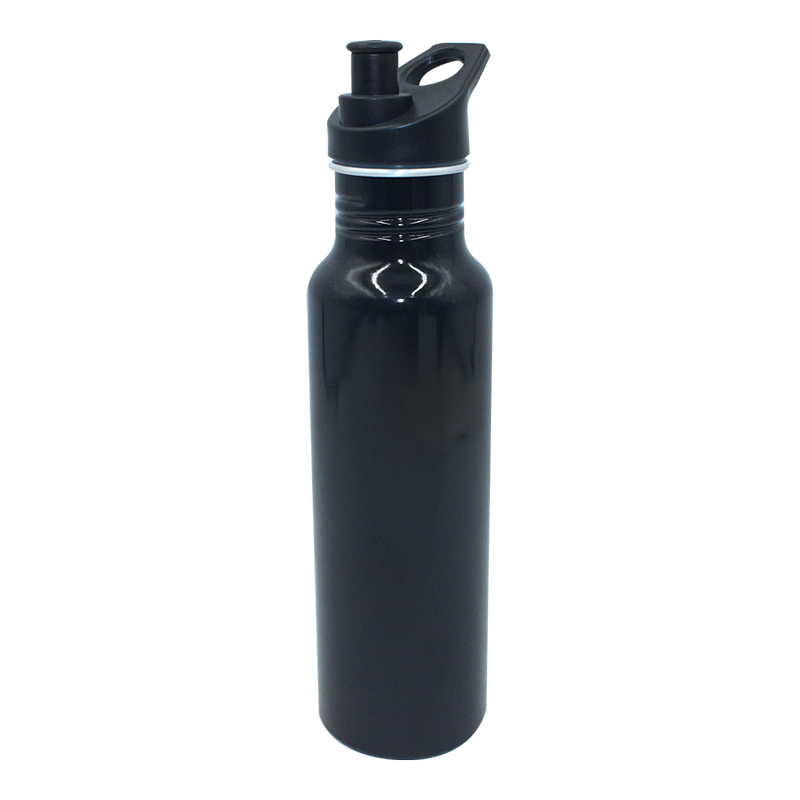
- Aluminum line (single-wall only): 360ml / 500ml / 600ml / 750ml / 750ml sport / 500ml cola-shape. All with internal liner. MOQ 1,000 pieces per design.
- Stainless steel line (double-wall vacuum insulated): 16oz slim tumbler, 560ml coffee tumbler, 32oz 3-in-1 pet bottle, 17oz with silicone handle, 400ml leak-proof coffee cup. All 304 stainless steel, vacuum insulated, 6–8 hour heat retention. MOQ 500–1,000 pieces per design.
7. Frequently Asked Questions
Can you put boiling water in a single-wall aluminum bottle?
Yes, the aluminum itself tolerates boiling water easily (alloys 1100 and 3003 tolerate well above 100 °C). The relevant limits are: (1) the exterior surface becomes hot to touch — about 75–85 °C within 2 minutes when filled with 95 °C liquid; (2) the inner liner must be rated for that temperature (Sunsum’s epoxy, acrylic, and polyester liners are all rated above 100 °C). For most hot-coffee use (80–90 °C brew temp), Sunsum’s single-wall aluminum with a food-grade liner is acceptable.
Why doesn’t Sunsum China make double-wall aluminum bottles?
Because vacuum-insulated double-wall construction requires a stainless-steel inner vessel — aluminum cannot hold a vacuum reliably over years of use (its higher thermal expansion and lower fatigue strength cause vacuum seal failure). Sunsum’s double-wall vacuum insulated line is built in 304 stainless steel; the aluminum line is intentionally single-wall with an internal liner. This is a deliberate engineering decision, not a gap in the catalog.
How long does coffee stay hot in a single-wall aluminum bottle?
Industry-standard reference: a 600 ml single-wall aluminum bottle filled with 90 °C coffee loses heat at roughly 8–12 °C per 10 minutes (no insulation, single metal wall). After 30 minutes, expect 60–70 °C; after 60 minutes, expect 40–55 °C. This is the natural consequence of aluminum’s high thermal conductivity (~205 W/(m·K)) — the wall conducts heat rapidly outward to ambient air.
How long does coffee stay hot in a double-wall stainless steel vacuum bottle?
Industry-standard reference: a 500 ml double-wall 304 stainless steel vacuum-insulated bottle keeps 90 °C coffee above 65 °C for 6–8 hours, and above 50 °C for 12 hours. The vacuum gap eliminates convective heat transfer and the stainless steel walls cut conductive heat transfer roughly 13× compared to aluminum.
Is the epoxy liner safe with hot coffee?
Sunsum’s standard epoxy liner is BPA-free and compliant with FDA 21 CFR 175.300 (coatings for food-contact surfaces) and EU Regulation 1935/2004. The continuous-use temperature rating is 100 °C — well above typical coffee brewing temperatures (90–96 °C) and above the FDA-recommended coffee drinking temperature of 60 °C. For brewing directly in the bottle (rare), contact the factory for high-temperature-rated liner options.
What is the minimum order quantity for a custom logo single-wall aluminum bottle?
Sunsum China’s MOQ for custom logo single-wall aluminum bottles starts at 1,000 pieces per design per size (screen printing, heat{}transfer, or 4-color process). Standard colors are stocked at 3,000-piece MOQs; custom Pantone colors require 5,000-piece MOQs. Sample lead time is 7–10 days; bulk production lead time is 30–35 days after sample approval.
Can the same mold produce both single-wall aluminum and double-wall stainless steel bottles?
No — the manufacturing processes are entirely different. Single-wall aluminum bottles are impact-extruded from aluminum slug (1100 / 3003 alloy) with a single-pass draw and then internally coated. Double-wall stainless steel bottles require two stamped 304 stainless steel sheets welded together with a vacuum gap between them. Sunsum operates separate production lines for each.
Which Sunsum product should I specify for a hot-coffee private-label program?
For hot-coffee applications where temperature retention matters (commute coffee, outdoor catering, branded corporate gifts), specify the double-wall 304 stainless steel vacuum insulated tumbler or bottle. For cold beverages or short-duration warm drinks (under 20 minutes, hand-held use), the single-wall aluminum bottle is a cost-effective, lightweight choice. The two product lines complement each other — many buyers source both for split-purpose promotional kits.
8. Engineering Sources and How to Verify
The thermal conductivity figures, cooling curve numbers, and vacuum retention characteristics cited above are drawn from industry-standard reference data. For due diligence on your private-label program, request the following third-party documents from any supplier:
- Liner migration test report — per FDA 21 CFR 175.300 — confirms the inner coating is food-safe at the intended use temperature.
- EU food contact compliance declaration — per EU Regulation 1935/2004 — required for European retail and import.
- Thermal performance test report — filled with 95 °C water, measured at 1, 3, 6, 12 hours. Sunsum’s standard test uses 500 ml double-wall SS vacuum bottles, ambient 20 °C, lid closed.
- Material certificate — for stainless steel: 304 vs 316 confirmation with mill certificate; for aluminum: alloy 1100 vs 3003 confirmation.
9. Closing Recommendation and Where to Source
For a hot-coffee-focused private-label program, the right specification is Sunsum’s double-wall 304 stainless steel vacuum insulated bottle line. For a cold-beverage promotional program or short-duration warm drink, the single-wall aluminum bottle line is the lower-cost, lighter-to-ship choice.
Both lines share the same factory, the same QA system, and the same custom logo capabilities (screen print, heat transfer, 4-color process, laser engraving on stainless). Many of our brand clients run split inventories — aluminum for high-volume cold-drink giveaways, stainless steel for premium hot-coffee retail and corporate gifting.
For samples, MOQ clarification, or a custom proposal tailored to your program, contact our Sunsum China sales team. Sample lead time 7–10 days; bulk production 30–35 days.
Claire
Daily consumer goods specialist at Sunsum China, a professional manufacturer of custom aluminum water bottles, insulated tumblers, sports bottles, and drinkware. Expert in OEM/ODM custom manufacturing — from logo printing to color customization — helping global brands and retailers source premium, BPA-free drinkware with confidence. Dedicated to delivering functional, stylish products at competitive factory-direct pricing.
FDA 21 CFR 175.300 · Engineering Toolbox — Thermal Conductivity of Metals · EU Regulation 1935/2004
Post time: Aug-06-2026