
 The School District Procurement Challenge for Reusable Bottles
Working as a daily consumer goods specialist at Sunsum China, I help US school districts and their approved distributors source custom-branded reusable water bottles. The conversation always starts the same way: the district’s procurement officer, who may be responsible for everything from textbooks to toilet paper, suddenly has to qualify a food-contact product for 5,000-50,000 students. The first question is never about the bottle design or the colour range. It is always: “How do I know it is actually BPA-free?”
This question is harder to answer than it should be because “BPA-free” is not a regulated term in the United States. There is no federal definition of what it means for a product to claim BPA-free status. The term is a marketing claim that sits on top of a regulatory framework — FDA food contact substance notifications, California Proposition 65, and the Consumer Product Safety Improvement Act — that does not explicitly define or enforce the term.
In this guide, I walk through exactly what documentation US school districts should require from their water bottle suppliers to verify BPA-free status in a legally defensible manner, using Sunsum’s 600ml Tritan sports bottle as a reference product that meets these requirements.
The Three-Layer Compliance Framework
I recommend US school districts require three distinct compliance documents from their bottle supplier, each covering a different regulatory requirement.
Layer 1: FDA Food Contact Substance Notification (FCN) or 21 CFR Compliance
The material used to manufacture the bottle must either comply with an existing FDA regulation in 21 CFR (Title 21 of the Code of Federal Regulations, Parts 170-199 — Food Additives) or be the subject of a valid Food Contact Substance Notification (FCN) filed with the FDA. For Tritan copolyester — the material we use for Sunsum’s 600ml sports bottle — the manufacturer Eastman Chemical holds an FCN for the Tritan material family, confirming that the polymer does not contain bisphenol A and meets the FDA’s extractable migration limits for food contact articles. The supplier should provide either the FCN number or a letter from the resin manufacturer certifying 21 CFR compliance. The letter should reference the specific 21 CFR section applicable to the material — for Tritan, this is typically 21 CFR 177.1520 (olefin polymers). A generic “complies with FDA regulations” statement without a cited regulation section is not sufficient for a school district’s procurement compliance file.
Layer 2: California Proposition 65 Lead and Cadmium Limits
California Proposition 65 requires businesses to provide warnings about significant exposures to chemicals that cause cancer, birth defects, or other reproductive harm. For children’s reusable food containers — and school-age children are the end users — the Proposition 65 maximum allowable dose level (MADL) for lead in a reusable beverage container is 0.5 micrograms per day. The supplier should provide a laboratory test report from an ISO 17025-accredited laboratory showing that the bottle’s extractable lead and cadmium levels are below the Proposition 65 safe harbor limits. The test should be conducted on the finished bottle, not just the resin, because lead can be introduced during the moulding process through the pigment masterbatch or the mould release agent.
Layer 3: FDA 21 CFR 175.300 for the Printing Ink or Decoration
This is the layer that most suppliers overlook. The decorative print on the bottle — the school district logo, the mascot, or the sustainability messaging — must meet FDA 21 CFR 175.300 (resinous and polymeric coatings) if the ink is in direct contact with food, or must be separated from the food by a functional barrier if the print is on the outer surface. For a clear Tritan bottle where the print is on the outer surface (typically screen-printed or UV-cured), the functional barrier is the Tritan wall itself — but the supplier must confirm that the ink does not migrate through the bottle wall during repeated use and dishwashing. Sunsum uses UV-cured printing ink that is tested for migrating compounds under FDA 21 CFR 175.300 conditional use and provides the test report with every custom-printed order for school districts.
Material Selection: Why Tritan Copolyester Dominates the US School Market
Tritan copolyester has become the dominant material for school district reusable water bottles in the United States for three reasons that go beyond its BPA-free status.
Durability and Dishwasher Safety
Polycarbonate bottles — the pre-2010 standard — are brittle and crack when dropped on a hard school cafeteria floor. Polypropylene bottles are more impact-resistant but develop stress cracking at the shoulder and thread areas after 50-80 dishwasher cycles. Tritan bottles withstand 500+ dishwasher cycles on the top rack without visible degradation, haze, or cracking. The impact resistance of Tritan is approximately 3-5 times that of polycarbonate in the Izod notched impact test (ASTM D256), making it significantly safer for the school environment where bottles are dropped, thrown into backpacks, and washed daily.
Clarity and Aesthetic Appeal
Tritan has a water-clear transparency that approaches polycarbonate and is unmatched by polypropylene or polyethylene. For a school district investing in custom-printed bottles with their logo and branding, the visual appeal matters — students are more likely to use and retain a bottle that looks clean and modern. Sunsum’s 600ml Tritan sports bottle achieves a haze value of less than 1.0 percent (ASTM D1003), making it indistinguishable from glass in clarity while weighing 85-110 grams depending on the specific mould design.
Temperature Range and Insulation Options
Tritan has a continuous service temperature range of -40°C to 100°C, suitable for dishwasher hot cycles and for filling with hot (but not boiling) beverages. The 600ml bottle from Sunsum is compatible with all standard school hydration station fillers (Elkay, Oasis, Halsey Taylor) that dispense chilled water at 8-15°C — the bottle does not impart flavour or odour to the water, and the material does not retain odour from previous use.
Order Specifications for US School Districts
When a school district procurement team issues an RFP for custom reusable water bottles, the following specification points should be included in the technical requirements.
| Specification Item | Recommendation for 600ml Sports Bottle |
|---|---|
| Material | Tritan copolyester (Eastman TX1000 or equivalent) |
| Capacity | 600 ml (20 oz) — standard for school hydration stations |
| Weight | 85-110 grams per bottle |
| Bottle mouth diameter | 63mm — compatible with standard bottle filling stations |
| Cap type | Push-pull sports cap or flip-top straw cap |
| Dishwasher safe | Top rack, 500+ cycles minimum |
| Printing method | UV digital transfer or screen print — full colour logo |
| Certification required | Third-party BPA-free lab report, Prop 65 compliance, FDA 21 CFR |
| Packaging | Individual polybag with paper insert, 48 bottles per master carton |
Sustainability Reporting and District ESG Requirements
US school districts are increasingly required to include sustainability metrics in their annual procurement reports. The reusable water bottle program is one of the most visible sustainability initiatives a district can implement.
Plastic Waste Reduction Quantification
A single school district transitioning from disposable plastic water bottles to reusable bottles eliminates approximately 200-400 single-use plastic bottles per student per year. For a mid-size district of 10,000 students, that is 2-4 million plastic bottles kept out of the waste stream annually. The greenhouse gas reduction from avoiding the production, transport, and disposal of those plastic bottles is approximately 80-160 tonnes of CO₂ equivalent per year — calculated using the EPA’s WARM (Waste Reduction Model) tool. I recommend school districts request a waste reduction calculation sheet from their bottle supplier for inclusion in their annual sustainability report. Sunsum provides a custom waste reduction calculator for each district order, populated with the order quantity, the estimated replacement rate (typically 1.5-2 bottles per student per year), and the plastic weight of the equivalent disposable bottles.
Material Circularity and End-of-Life Options
Tritan copolyester is recyclable in the #7 plastics stream (Other) accepted by most US municipal recycling programs. The bottle should be emptied, rinsed, and the cap removed before recycling. For school districts with a zero-waste goal, Sunsum offers a take-back program for quantities above 10,000 units: the district collects the used bottles at the end of the program cycle, Sunsum arranges freight to a recycling facility, and the recycled material is used to manufacture new non-food plastic products. The take-back program adds approximately USD 0.05 per unit to the bottle cost but generates positive media coverage and can be highlighted in the district’s sustainability communications.
Frequently Asked Questions
What is the minimum order quantity for custom-printed sports bottles with a school district logo?
For screen-printed or UV digital transfer custom logos, Sunsum’s standard MOQ is 1,000 units per design per colour. For a school district ordering for 5,000 students across 8 elementary schools, 3 middle schools, and 2 high schools with different logos per level, the order can be split across the 3 logo variants at 1,000 units per variant, with the remaining 2,000 units as a generic district-wide bottle. The printing plate or digital file setup cost is typically USD 80-150 per logo colour, waived for orders above 3,000 units. For embossed or debossed logos (moulded into the bottle surface rather than printed), the MOQ is 10,000 units because the mould modification cost is higher.
Do the bottles include a BPA-free label on the product or packaging?
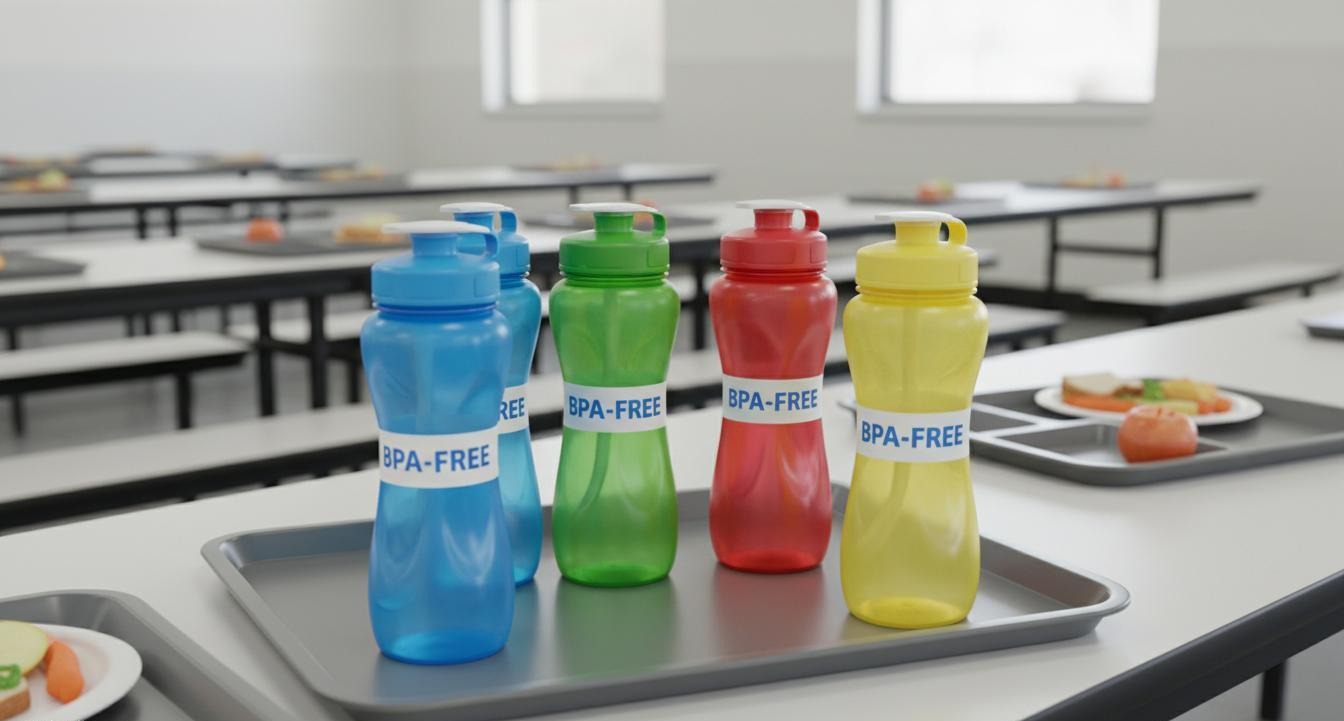
Yes. Sunsum’s standard 600ml Tritan sports bottle is labelled “BPA-Free” on the back of the bottle (moulded into the material) and on the individual product hang tag. The labelling includes the material type (Eastman Tritan), the capacity (600ml / 20 oz), and the dishwasher safety marking. For school district custom orders, the BPA-Free marking can be omitted from the bottle body at the district’s request if the district prefers a cleaner aesthetic, but we recommend keeping it on the packaging insert because it is the first question every parent asks when their child brings home a school-issued water bottle.
What is the lead time for a school district order of 5,000-20,000 units?
For a standard Tritan 600ml bottle order with single-colour screen print, the production lead time is 25-35 working days from confirmed order and deposit approval. Custom colour matching for the bottle material (the Tritan resin can be tinted to the district’s specific colour) adds 5 working days. Sea freight from Ningbo, China to the Port of Los Angeles or Long Beach takes 16-20 days. Customs clearance and inland delivery takes an additional 5-8 working days. Total lead time from order to school district warehouse arrival: 50-65 working days (10-13 weeks). I recommend school districts place their orders by January for August/September delivery at the start of the academic year. Rush production (15 working days) is available for orders above 10,000 units with air freight option, but the freight cost increases from approximately USD 0.10-0.15 per unit (sea) to USD 0.60-0.90 per unit (air).
Can the 600ml bottles be used with the Elkay EZH20 bottle filling station?
Yes. The Sunsum 600ml Tritan sports bottle has a 63mm mouth diameter that fits all standard bottle filling stations installed in US schools, including the Elkay EZH20 series, the Oasis Versacooler bottle filler, and the Halsey Taylor hydration stations. The bottle height is 210mm — compatible with the infrared sensor trigger height on these stations. The tapered bottom of the bottle is designed to sit securely in the filling station’s drip tray without tipping. We tested the bottle on an Elkay LZWSR8 (the most common school model in the United States) and confirmed 100 percent sensor activation and drip-free filling at the standard sensor nozzle position.
What warranty does Sunsum offer on custom-printed school water bottles?
Sunsum offers a 1-year warranty on the bottle body against manufacturing defects — including material defects such as bottle wall delamination, stress cracking at the thread area under normal use, and cap seal failure. The warranty covers the printed logo against peeling or fading for 200 dishwasher cycles (top rack, no heat dry) under ASTM F1886 standard test conditions. The warranty excludes damage from misuse (freezing the bottle with a full liquid, exposure to microwave ovens, contact with abrasive cleaners), intentional damage, and normal wear of the cap seal (which should be replaced every 6-12 months in school use). Warranty claims are typically processed within 10 working days from receipt of a photo of the defective unit — replacement bottles are shipped from our US-based regional distribution partners in California and New Jersey.