

TL;DR
Southeast Asian fitness brands are rapidly adopting 2-in-1 stainless steel water bottles featuring removable cup designs that serve dual hydration purposes. The removable cup base allows users to drink more naturally during workouts without head-tilt, while the attached bottle provides on-the-go hydration capacity. For fitness retailers and wholesale buyers, these bottles command 30-50% higher retail prices than standard single-function bottles, improving margins significantly. The tropical climate of Southeast Asia — with average temperatures of 26-32°C and humidity above 80% — creates constant hydration needs that the 2-in-1 design addresses more effectively than conventional bottles. This article examines the product design rationale, manufacturing specifications, OEM/ODM customization options, and regulatory compliance requirements for buyers entering this growing market segment.
When I joined Sunsum as their daily consumer goods specialist, one of the first observations I made was that the Southeast Asian fitness market was underserved by hydration products that accounted for the region’s unique climate and usage patterns. Standard water bottles designed for temperate markets — with narrow necks, flip-top lids, and rigid construction — do not perform well in hot, humid conditions where users want to drink quickly and comfortably during intense workouts. The 2-in-1 removable cup design addresses this gap directly.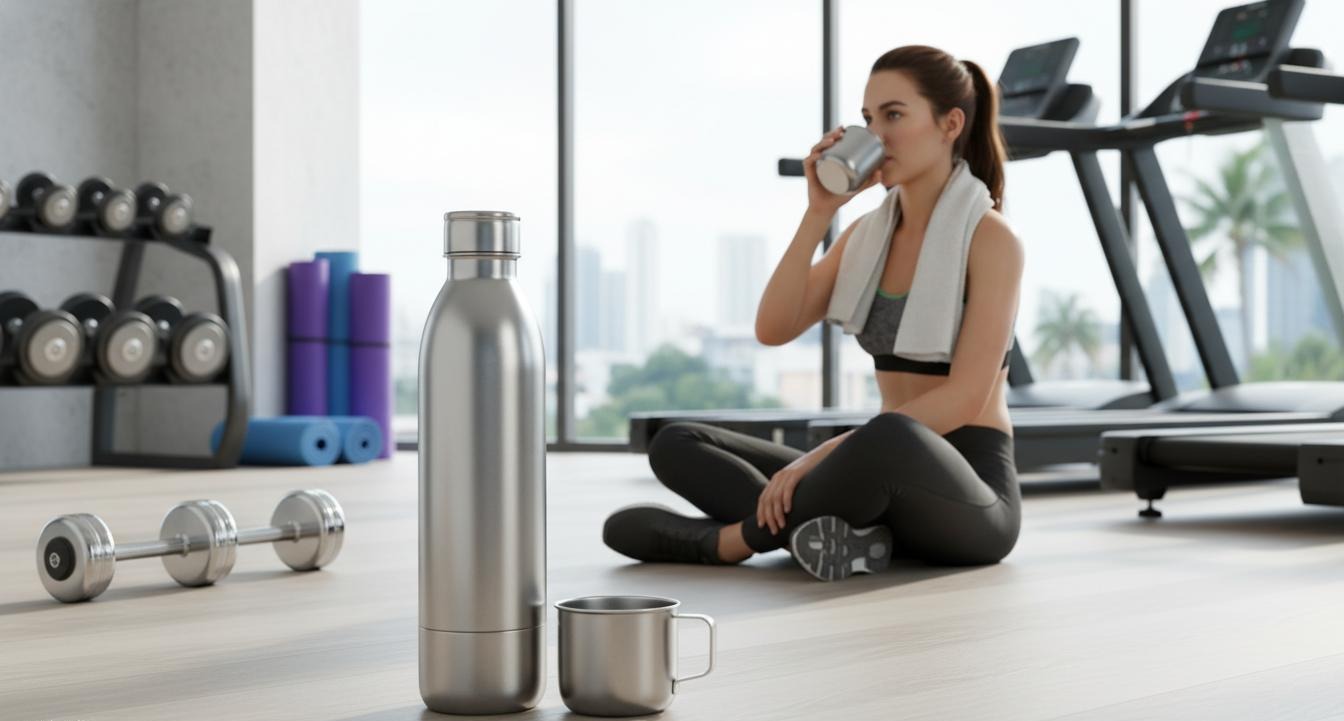
Understanding the 2-in-1 Design: Form and Function
The 2-in-1 stainless steel water bottle with removable cup design is structurally distinct from conventional water bottles. The bottle consists of two primary functional components: the main vessel (the bottle body with its insulated walls and sealed cap) and the removable cup base (which threads or snaps onto the bottom of the bottle to form a stable, standalone drinking vessel).
When assembled, the unit functions as a standard insulated water bottle with a carry handle, wide mouth for filling and cleaning, and the full thermal retention properties of the vacuum-insulated construction. When the cup base is removed, the user has a stable, wide-mouthed drinking cup with no lid to manipulate — ideal for rapid hydration during a workout interval or for casual drinking at a desk. The cup base typically has a capacity of 250-400ml, while the full bottle may hold 500-750ml, giving users flexibility in how they access their hydration.
The mechanical connection between the bottle body and the cup base is the critical design element. Threaded connections provide secure attachment but require the user to unscrew the base for cup use — which can be inconvenient during a workout. Bayonet-style or quick-release clip mechanisms allow faster conversion between bottle and cup modes, and these are increasingly preferred in fitness-oriented products. Some designs incorporate a twist-lock mechanism that provides both secure attachment and easy release with a quarter-turn rotation.
Why Southeast Asian Fitness Consumers Want This Design
The Southeast Asian fitness market has unique characteristics that drive demand for 2-in-1 bottle designs. Average temperatures across the region range from 26°C to 32°C year-round, with humidity levels frequently exceeding 80%. Outdoor fitness activities — running, cycling, outdoor gym workouts, sports training — expose participants to significant heat stress that accelerates fluid loss through perspiration. Maintaining adequate hydration during exercise in these conditions requires easy, rapid access to water in quantities that exceed what a small cup or standard bottle mouth can provide in a single drink.
The 2-in-1 design addresses this need by allowing users to pour water from the bottle into the cup and drink from the wide-mouth cup without the awkward head-tilt movement required by narrow-neck bottles. During a running interval or between sets at an outdoor gym, this matters. The cup provides a drinking surface area roughly three to four times larger than the opening of a standard water bottle neck, allowing users to consume more water per swallow and reducing the time spent drinking.
The fitness culture in Southeast Asia is also increasingly social and image-conscious, particularly among the growing middle class in Thailand, Vietnam, and Indonesia. Fitness enthusiasts in these markets often share their workout gear on social media, and a visually distinctive water bottle — with a unique 2-in-1 form factor and premium materials — serves as both a functional tool and a status marker. Brands that offer products with clear design differentiation command loyalty from consumers who want their gear to reflect their identity and commitment to fitness.
The Economic Case for 2-in-1 Bottles in Retail Strategy
From a retail strategy perspective, 2-in-1 stainless steel bottles represent a compelling category for Southeast Asian fitness retailers. The dual-functionality design justifies a retail price point 30-50% higher than equivalent single-function bottles, improving gross margins substantially.
A standard 500ml insulated stainless steel bottle — with vacuum insulation, 18/8 stainless steel construction, and a leak-proof lid — typically retails in Southeast Asian markets for USD 18-28 depending on brand positioning and distribution channel. A comparable 2-in-1 bottle with removable cup design from the same manufacturer may retail for USD 28-42, while a premium brand with strong design heritage and marketing investment may command USD 45-65 per unit. The manufacturing cost differential between the standard bottle and the 2-in-1 version is typically USD 4-8 per unit — meaning the premium pricing delivers disproportionate margin improvement.
Retailers also benefit from the 2-in-1 format’s appeal in gifting occasions. The bottle-with-cup design reads as a more complete gift than a single-function bottle — it suggests thoughtful design consideration and practical versatility. Major gifting occasions in Southeast Asia include religious festivals (Songkran in Thailand, Hari Raya in Malaysia and Indonesia), company year-end gifts, and personal milestones like fitness achievements. Retailers report stronger sell-through during gifting seasons when products are packaged with clear dual-purpose messaging.
Vacuum Insulation: The Technology That Makes It Work
The thermal retention performance of 2-in-1 stainless bottles depends on the vacuum insulation system used in the bottle body. Vacuum insulation — in which a near-perfect vacuum exists between double stainless steel walls — is the most effective thermal barrier available in consumer drinkware, providing significantly better performance than foam insulation or single-wall construction.
In tropical markets, insulation performance is a critical specification. A bottle that keeps water cold for 24 hours in a 25°C air-conditioned office but warms to undrinkable temperatures within 4 hours in a 32°C outdoor gym offers poor value to Southeast Asian consumers who may carry their bottle through a full day of variable conditions. Quality vacuum-insulated bottles for tropical markets should specify cold retention of 24+ hours and hot retention of 12+ hours under real-world conditions — not just the ideal-condition test values sometimes used in marketing materials.
The vacuum quality between the walls directly affects insulation performance. High-quality manufacturers use electron beam welding to seal the double-wall construction, creating a vacuum level below 10^-3 Pascal that provides optimal thermal resistance. Lower-quality manufacturing may use resistance welding or other less effective sealing methods that result in higher residual gas pressure in the vacuum space, degrading insulation performance over time.
Copper lining between the walls — applied as a reflective coating on one or both surfaces of the vacuum gap — provides additional thermal performance improvement by reflecting radiant heat back into the beverage (for cold drinks) or back into the bottle (for hot drinks). This feature is common in premium products and is worth specifying for retailers targeting the mid-to-premium market segment.
Material Specifications for Tropical Climate Durability
Stainless steel water bottles destined for Southeast Asian markets must meet material specifications that account for the region’s climate challenges. The combination of high temperature, high humidity, salt exposure (in coastal areas), and the chemical composition of tap water in some markets creates conditions that can degrade inferior products rapidly.
The primary material for bottle construction should be 304 stainless steel (also known as 18/8, containing 18% chromium and 8% nickel). This grade offers excellent corrosion resistance, food safety compliance, and structural strength at temperatures from -40°C to 800°C. It is the standard for food contact applications globally and is accepted under all major food safety regulatory frameworks. Some manufacturers offer 316 stainless steel (18/10, with added molybdenum for improved chloride resistance) for products intended for marine or coastal use environments, which provides additional corrosion resistance at a slightly higher cost.
The interior surface of the bottle should be finished to a sanitary standard — typically electropolished or with a non-coated mirror finish that is easy to clean and does not impart flavor to beverages. Interior coatings (such as epoxy or ceramic linings) are sometimes used to address flavor retention concerns with certain beverage types, but they add cost and may chip or degrade over time. For general-purpose hydration use, a high-quality 304 stainless steel interior surface with proper electropolishing is the preferred specification.
The removable cup base is typically manufactured from either stainless steel (matching the bottle body for visual consistency) or from BPA-free Tritan copolyester (for a lighter weight and lower cost option). Tritan cups are popular in fitness-oriented products because they are lighter, less likely to dent if dropped, and offer transparency that allows users to see how much liquid remains in the cup.
The Engineering Challenge: Leak Prevention in Dual-Function Designs
Leak prevention is the most technically demanding aspect of 2-in-1 bottle design, and it is the primary reason that poorly designed products fail in the market despite attractive aesthetics and competitive pricing. When a bottle has two functional modes — sealed bottle and open cup — the sealing mechanism must perform flawlessly in both configurations.
The primary seal between the bottle body and the cup base typically uses a food-grade silicone gasket seated in a groove in the cup base. When the cup base is threaded or locked onto the bottle body, the gasket compresses against the bottom rim of the bottle, creating a watertight seal. The compression force must be sufficient to prevent leakage under normal conditions but not so excessive that the mechanism becomes difficult to operate.
Secondary sealing occurs at the drinking interface — the lid, straw, or flip-top mechanism that controls access to the bottle’s contents when the bottle is in its closed configuration. This secondary seal must prevent leakage when the bottle is stored in a gym bag, backpack, or travel luggage where external pressure and movement can stress the seal.
Quality manufacturers conduct multiple leak test protocols during production: positive pressure testing (simulating the pressure buildup that occurs when a sealed bottle warms in a hot car), vacuum testing (simulating the pressure drop that occurs when a sealed bottle cools during air travel), and orientation testing (checking for leaks when the bottle is stored on its side or upside down). Buyers should request leak test documentation from suppliers and conduct independent testing on pre-shipment samples to verify seal performance.
OEM and ODM Customization Pathways for Brand Buyers
For fitness brands and retailers looking to develop proprietary 2-in-1 bottle product lines, OEM and ODM manufacturing arrangements with Chinese producers offer multiple customization pathways. Understanding these pathways helps buyers select the approach that best matches their brand positioning, volume expectations, and investment capacity.
OEM (Original Equipment Manufacturing) arrangements involve the buyer providing detailed product specifications that the manufacturer produces exclusively for the buyer’s brand. The buyer controls design, materials, colors, branding, and packaging. OEM arrangements typically require minimum order quantities of 1,000-5,000 units per SKU and involve tooling investments of USD 5,000-20,000 for custom injection molds, casting dies, or stamping tools. This approach is appropriate for established brands with sufficient volume to justify the upfront investment and the need for full design control.
ODM (Original Design Manufacturing) arrangements involve the manufacturer offering standard product platforms that can be customized within defined parameters. ODM products typically have base designs that have been refined through production experience and market feedback, with customization options for colors, logos, surface finishes, and packaging. ODM arrangements reduce the upfront tooling investment (often requiring only logo printing tooling at USD 500-2,000) and lower minimum order quantities to 200-500 units per SKU. This approach is appropriate for emerging brands, regional retailers testing product concepts, or buyers who want to access proven designs with brand-specific customization.
Sunsum operates both OEM and ODM models for its stainless steel water bottle and tumbler products, with customization options spanning color matching (Pantone system), logo application (screen printing, laser engraving, heat transfer, pad printing), surface finishes (powder coating, brushed steel, mirror polish, dip dye), and packaging (gift box, mailer box, sustainable materials). Buyers entering this product category for the first time often find that starting with an ODM arrangement allows them to test market response with lower risk before committing to OEM investment.
Regulatory Compliance for Southeast Asian Markets
Stainless steel water bottles sold as food contact articles in Southeast Asian markets must comply with applicable national regulatory frameworks. These requirements vary by country, and buyers should verify compliance requirements for each market they intend to serve.
Singapore’s SFA (Singapore Food Agency) enforces food safety regulations under the Sale of Food Act. Food contact articles, including stainless steel drinking vessels, must not leach hazardous substances at levels exceeding the prescribed limits. The SFA also requires that food contact articles be manufactured under conditions that meet recognized food safety standards (such as ISO 22000 or equivalent). Products with false or misleading claims about material safety or performance may be subject to enforcement action under the Consumer Protection (Trade Descriptions and Fair Trading) Act.
Thailand’s FDA (Food and Drug Administration) regulates food contact products under the Food and Drug Act. Stainless steel food contact articles must comply with Thai standards for heavy metal migration limits (particularly lead, cadmium, and chromium). Importers must register food contact products with the Thai FDA before commercial sale, and product labels must be in Thai language with required disclosures including manufacturer information, material specifications, and usage instructions.
Indonesia’s BPOM (Badan POM — Food and Drug Administration) requires registration of food contact articles sold in Indonesia under the Harmonization of National Regulations framework. The registration process requires submission of product specifications, material safety data, testing results from accredited laboratories, and manufacturing facility documentation. Processing times for BPOM registration can be 3-6 months, so buyers planning Indonesian market entry should factor this timeline into their product launch planning.
Malaysia’s MOH (Ministry of Health) regulates food contact products under the Food Act 1983 and associated regulations. Products must meet the Malaysia Food Regulations 1985 requirements for food contact materials, including heavy metal migration limits and material safety standards. The SIRIM certification mark may be required or expected for certain product categories, providing independent verification of quality and safety compliance.
Competitive Landscape: Who Is Winning in Southeast Asian 2-in-1 Bottle Sales
The Southeast Asian market for 2-in-1 stainless steel water bottles is populated by a mix of international brands with regional presence, local brands with strong market positions, and white-label manufacturers supplying distributors and retailers. Understanding the competitive landscape helps new entrants identify positioning opportunities.
Premium international brands — including Hydro Flask, YETI, and Stanley — compete in the high-end segment with products priced at USD 40-80 per bottle. These brands benefit from strong global recognition, premium manufacturing quality, and established distribution networks. However, their pricing positions them beyond the reach of many Southeast Asian consumers, and they face limited customization options for regional market requirements.
Regional brands — including Singapore’s Camelbak-equivalent offerings, Thai fitness brands, and Indonesian consumer goods companies — have built market positions through local distribution networks and understanding of regional consumer preferences. These brands often work with OEM manufacturers to develop proprietary products with distinctive designs and competitive pricing in the USD 25-45 range.
Chinese manufacturers selling direct-to-consumer through e-commerce platforms represent an emerging competitive threat to traditional retail channels. Platforms like Shopee, Lazada, and Tokopedia host numerous Chinese-manufactured 2-in-1 bottles at price points of USD 12-22, capturing price-sensitive consumers who prioritize cost over brand. These products vary significantly in quality, and the lowest-priced options often fail in leak prevention and durability testing, but they create price pressure throughout the market.
Supply Chain Considerations for Southeast Asian Distribution
Getting 2-in-1 stainless steel bottles from Chinese manufacturing facilities to Southeast Asian distribution hubs involves supply chain decisions that affect both landed cost and product quality upon arrival.
Manufacturing locations for stainless steel drinkware are concentrated in China’s Zhejiang province (particularly the Hangzhou-Ningbo corridor), which is home to the largest cluster of stainless steel bottle manufacturers in the world. The Ningbo port is the primary export hub for this region, with efficient container shipping services to all major Southeast Asian ports. Transit times range from 4 to 8 days to Singapore, 7 to 12 days to Port Klang (Malaysia), and 10 to 15 days to Jakarta or Manila.
Sea freight is the dominant shipping mode for standard orders, with container shipping costs of USD 0.50-1.20 per kilogram depending on volume and fuel conditions. For time-sensitive orders or new product launches, air freight may be necessary despite significantly higher costs (USD 3-6 per kilogram). The per-kilogram density of stainless steel bottles (a 500ml bottle weighs approximately 350-450 grams) means that even air freight adds only USD 1.50-3.00 to the per-unit landed cost for most shipments.
Packaging for ocean freight to tropical markets should account for high humidity and salt air exposure during transit. Individual bottles should be sealed in polyethylene bags with desiccant packs to prevent internal condensation. Inner cartons should use moisture-resistant materials or include interior barriers. Palletization should ensure adequate ventilation to prevent container humidity buildup during transit.
Quality Control Protocols for 2-in-1 Stainless Bottles
Wholesale buyers importing 2-in-1 stainless steel bottles should implement quality control protocols that address the specific failure modes most common in this product category. Standard inspection procedures may miss issues that materially affect product performance and brand reputation.
Leak testing should be conducted on a statistically representative sample from each production lot. The recommended sampling plan is AQL 1.5 for critical defects (leakage, structural failure) and AQL 4.0 for minor defects (cosmetic issues, packaging damage). Testing protocols should include: assembly and disassembly testing (verifying that the cup base attaches and releases without resistance and without degradation after 50 cycles), thermal cycling (exposing the bottle to temperature ranges from 0°C to 50°C to simulate tropical storage and use conditions), and orientation testing (checking for leaks when the bottle is stored in various positions).
Material verification should confirm that the stainless steel used matches specifications. This can be done through X-ray fluorescence (XRF) testing of the bottle body and cup base at an independent laboratory, or through supplier certification with independent verification. Material misidentification — using 201 stainless steel or other lower-grade materials that may leach higher levels of heavy metals — is a documented issue in some import shipments and should be verified before products enter the distribution chain.
Insulation performance verification should be conducted on samples from each production lot. The standard test involves filling the bottle with ice water, sealing it, and measuring the temperature after 24 hours at a controlled ambient temperature of 20°C. A properly insulated bottle should maintain the water temperature below 8°C (meaning the ice has not fully melted) after this period. Products that fail this test should be rejected or renegotiated with the supplier.
Product Line Extensions from Core 2-in-1 Design
The 2-in-1 bottle design creates natural opportunities for product line extensions that allow brands to capture additional market segments and increase customer wallet share. Understanding these extensions helps buyers plan comprehensive product strategies.
Size variants are the most straightforward extension. Core 2-in-1 designs are typically offered in 500ml and 750ml capacities for the bottle body, with cup base capacities of 300ml and 400ml respectively. Adding a 350ml compact version (with a 200ml cup base) captures the personal carry market and consumers who prefer smaller, lighter bottles for everyday use.
Sport-specific variants address the distinct needs of different fitness activities. A cycling-oriented version might include a cage-mount compatibility feature in the cup base. A running version might include a hand-grip texture on the bottle body for easier carrying without the cup attached. A gym version might include a measurements scale printed on the interior of the cup base for tracking protein or supplement intake.
Kids and family variants extend the product to younger users with modified proportions and design aesthetics. Colors and patterns can be adapted for younger markets, and safety specifications (such as rounded edges and extra-durable materials) address parental concerns about product suitability for children.
The Sustainability Angle: BPA-Free and Environmental Claims
Environmental and health-related product claims are increasingly important in Southeast Asian consumer purchasing decisions, particularly in the premium and mid-market segments where brand-conscious consumers are willing to pay more for products that align with their values.
BPA-free certification is the baseline expectation in this category. Bisphenol A (BPA) is a chemical compound used in some polycarbonate plastics and epoxy linings that has been associated with potential health effects at certain exposure levels. All major markets have moved toward restricting BPA in products intended for food contact, and consumers are increasingly aware of and concerned about BPA exposure. Products should be verified as BPA-free through third-party testing, and this claim should be prominently featured in marketing materials and on-product labeling.
Sustainability claims extend beyond BPA-free to encompass the environmental footprint of the product itself. Stainless steel bottles, as reusable alternatives to single-use plastic bottles, carry an inherent sustainability advantage. Products that emphasize this advantage — through messaging about single-use plastic reduction, the longevity of stainless steel construction, and the environmental cost of disposable hydration — connect with consumers who are increasingly environmentally conscious.
Packaging sustainability is another emerging consideration. Products packaged in recycled cardboard with minimal plastic wrapping appeal to environmentally conscious consumers. Some brands have eliminated product plastic bags entirely, using only the product box for protection during shipping and retail display.
Conclusion: The Strategic Opportunity in 2-in-1 Stainless Bottles
The Southeast Asian market for 2-in-1 stainless steel water bottles with removable cup designs represents a strategic opportunity for fitness brands, retailers, and wholesale buyers who understand the unique demands of this market and can position products accordingly. The combination of tropical climate conditions, growing fitness culture, rising consumer purchasing power, and increasing demand for premium hydration solutions creates favorable conditions for well-positioned products.
The 2-in-1 design addresses real consumer needs: easy, rapid hydration during workouts without the awkward head-tilt of narrow-neck bottles; dual functionality that provides value beyond single-purpose alternatives; and premium materials and design that align with the status-conscious identity of fitness-oriented consumers. These needs are not unique to Southeast Asia, but they are particularly acute in a market where year-round high temperatures and humidity create constant hydration demands that conventional products do not fully address.
For wholesale buyers, the path to success involves selecting manufacturers with proven vacuum insulation expertise and documented leak prevention performance, specifying materials that meet food safety standards across all target markets, and structuring inventory to match seasonal demand patterns in each country. Building long-term supplier relationships — rather than pursuing transactional purchasing — delivers better quality accountability, more responsive customization options, and more reliable supply during tight market conditions.
The market is growing, the competitive landscape is still developing, and the fundamentals of consumer need strongly favor continued adoption of dual-purpose hydration solutions. Understanding these dynamics — and acting on them with strategic product selection and supplier partnerships — is how buyers capture margin and market share in one of Southeast Asia’s most promising consumer goods categories.
Post time: Jun-12-2026